Where Procurement Teams Actually Get Stuck: The Reality of Scope 3
The initial shock for most procurement teams arrives the moment they realise Scope 3 emissions cannot simply be "collected" via a spreadsheet. It is not a standard reporting exercise; it is a transformation effort that extends far beyond procurement itself. While gathering data from suppliers sounds straightforward in a boardroom, the operational reality spans multiple supplier tiers, fragmented data sources, and information that often sits entirely outside your direct control.
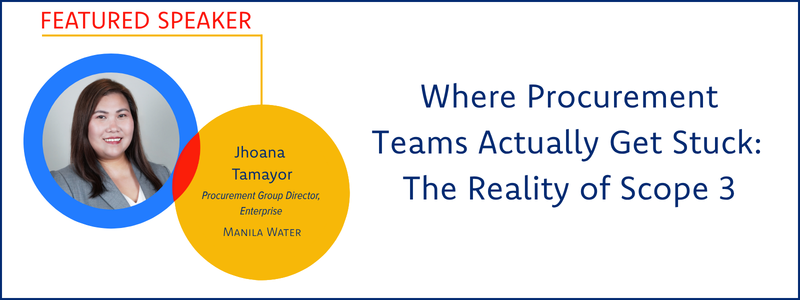
Drawing on her experience navigating early-stage Scope 3 initiatives, Jhoana Tamayor, Procurement Group Director, Enterprise, Manila Water believes many organisations underestimate how quickly Scope 3 evolves from a reporting exercise into a broader operational challenge.
Stitching together financial data, operational metrics, and supplier inputs to build visibility across an entire value chain is inherently more complex than managing Scope 1 and Scope 2 emissions.
The Data Trust and Maturity Dilemma
The fundamental hurdle in Scope 3 reporting is a lack of data ownership. Procurement teams are forced to rely heavily on a supply base where many partners are still developing the capability, systems, and knowledge required to measure emissions consistently.
Key Takeaway: The real challenge isn't that suppliers are actively withholding information, it is that data maturity across the supply base is incredibly uneven.
Even when suppliers appear highly cooperative and credible on the surface, deeper discussions can reveal significant gaps in capability. In some cases, suppliers initially appeared to have comprehensive plans covering Scope 1, 2, and 3 emissions. However, as conversations progressed, it became clear they were still in the early stages of understanding how to baseline and manage Scope 3 emissions themselves.
This creates an operational patchwork of supplier data, estimates, and assumptions that makes consistency and comparability a constant challenge.
The issue is rarely unwillingness. More often, it is a reflection of where suppliers are on their own sustainability journey.

Overcoming the Document Avalanche: Why Template Simplification Matters
Aligning expectations is where supplier conversations frequently become difficult. Procurement requires structured, specific information that can support reporting and decision-making, while suppliers are often working with limited resources and different reporting standards.
One practical adjustment many teams can make is simplifying how information is requested.
Historically, suppliers were often asked to provide various Health, Safety, and Environment (HSE) documents, certifications, and supporting materials. While these documents provided useful context, reviewing large volumes of different formats quickly became difficult for internal teams to assess consistently.
To reduce the burden on both suppliers and internal reviewers, a prescribed supplier declaration form was introduced.
Rather than collecting numerous supporting documents, suppliers completed a standardised form that allowed procurement teams to evaluate HSE standards in a more structured and consistent way.
The result was a simpler process and a more efficient way for procurement teams to evaluate supplier HSE standards.
The lesson is straightforward: successful supplier engagement is not necessarily about collecting more information. It is about making it easier for suppliers to provide the information that matters.
The Internal Intersection Gridlock: Sourcing vs Reality
On an organisational chart, Scope 3 initiatives often stall at the intersection of sustainability, procurement, and operations. While each function plays a critical role, no single department owns the complete picture. This challenge extends far beyond sustainability reporting. The 2026 ProcureCon Asia Benchmark Report found that 39% of procurement leaders cite functional silos and poor cross-functional collaboration as the single biggest barrier to increasing procurement's strategic impact.
Internal alignment frequently breaks down around data accuracy and data ownership.
A common point of friction occurs when information is assumed to be "procurement data" simply because it originated during sourcing and contracting activities.
Procurement teams typically hold the baseline information agreed during sourcing exercises and contract negotiations. However, operational realities often evolve once implementation begins.
For example, the number of personnel deployed, equipment utilised, or resources required may change based on actual site conditions. While procurement captured the original assumptions, these operational changes are often maintained by operations teams rather than procurement.
As a result, teams can find themselves debating which dataset should be used and which information is most accurate for emissions calculations.
Instead of moving initiatives forward, organisations can become stuck in discussions about data ownership and data validity.

Balancing Sustainability Ambitions With Procurement Reality
One of the most common misconceptions about Scope 3 is that sustainability objectives automatically conflict with commercial priorities.
For many organisations, however, carbon data maturity has not yet been formally embedded into sourcing decisions. Traditional factors such as cost, quality, service, and supplier capability continue to drive most procurement decisions today.
That does not mean the issue can be ignored.
Looking ahead, organisations will increasingly need clearer supplier selection criteria that incorporate carbon data maturity alongside traditional commercial measures. Establishing appropriate weightings, governance structures, and evaluation frameworks will help procurement teams navigate these decisions more consistently as sustainability becomes further embedded into sourcing processes.
Rather than viewing sustainability as a separate trade-off, the challenge will be integrating environmental considerations into existing supplier evaluation models in a practical and commercially realistic way.

Building a Repeatable System
Many organisations begin their Scope 3 journey focused on obtaining perfect data.
For Jhoana, one of the biggest lessons has been that many organisations begin their Scope 3 journey focused on obtaining perfect data.
The reality is that perfection is rarely available at the start.
Progress is often achieved by establishing an initial baseline, improving data quality over time, and building governance structures that support continuous improvement.
The organisations making the most progress are not necessarily those with the most mature datasets today. They are the ones creating repeatable processes that allow supplier engagement, reporting, and emissions visibility to improve year after year.
Key Takeaway: The real challenge of Scope 3 is not building your first carbon footprint—it is building a repeatable system.
For procurement leaders, that may be the most important lesson of all. Scope 3 is not a one-time reporting exercise. It is an ongoing capability that requires stronger supplier engagement, clearer ownership, and closer collaboration across procurement, sustainability, and operations.
The sooner organisations recognise that reality, the more effectively they can move from data collection to meaningful progress.