Why AI Procurement Pilots Fail in APAC and How to Fix Them
Here is what actually happened. The Walt Disney Company's procurement team in Asia Pacific ran AI-driven spend classification across their marketing and agency category. The model clustered suppliers, normalised rate cards, and surfaced something that manual category management had missed entirely: multiple business units were engaging overlapping agencies for nearly identical scopes — at significantly different prices.
This duplication had existed for some time. Different teams were making decisions independently, with limited visibility across business units. Without a consolidated view, pricing inconsistencies and supplier overlap remained hidden in plain sight. Nobody had spotted it. The AI did, in days.
What happened next is the part that matters. The insight did not go into a report. It did not surface in a quarterly review and get noted and forgotten. It restructured the sourcing event. Demand was consolidated across business units. Benchmark-driven negotiations replaced ad hoc rate discussions. The supplier base was rationalised toward a smaller, more accountable set of partners with defined performance metrics.
The cost reduction was real. But the more important outcome was this: the AI changed the nature of the decision that was made, not just the information available. That distinction — between AI as a reporting tool and AI embedded into sourcing decisions — is what determines whether AI in procurement scales or stalls.
Why AI Procurement Initiatives Fail (and It's Not the Technology)
Most procurement leaders, when an AI initiative stalls, will look first at the technology, then at the data, then at the vendor.
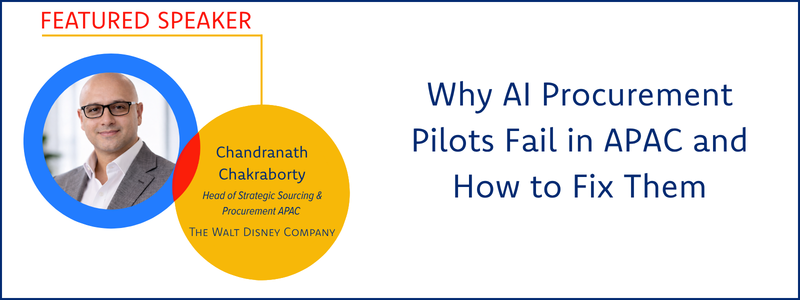
Chandranath Chakraborty, Head of Strategic Sourcing & Procurement APAC at The Walt Disney Company, is direct:
"If AI does not influence a supplier award, a negotiation strategy, or a purchasing decision, it remains theoretical. The failure is not the model. It's the absence of operational embedding."
Pilot purgatory in procurement is primarily an operating model issue, not a technology issue.
Procurement functions are often fragmented across categories, regions, and business units. Data definitions differ. Systems are not aligned. Decision rights are unclear. In this environment, even well-built AI tools struggle to move beyond isolated pilots because they are not connected to how decisions are actually made.
AI in procurement depends on standardisation, data quality, and clear ownership. Most organisations lack all three. Until governance is simplified and ownership is defined, adding more AI tools will not solve the problem. It will only generate more insights that sit outside execution.
Evaluating AI Vendors for Procurement: The Question That Matters
When evaluating AI tools, most procurement leaders focus on capability — what the tool can do, how accurate the model is, and how comprehensive the output appears.
To pressure-test this, ask:
- Where exactly will this change a decision in my current process?
If it does not sit inside a sourcing event, negotiation, or purchasing workflow, it will not deliver value. - Can you point to real implementations where this changed a sourcing decision?
If the decision point is unclear, the tool is not embedded into execution. - What does your implementation assume about our data readiness?
Most timelines assume cleaner procurement data than organisations actually have. If that assumption is wrong, everything downstream fails.
These questions force clarity on whether AI will influence decisions — or simply produce outputs.

AI Procurement in APAC: Why Japan, Southeast Asia, and Australia Need Different Approaches
The data challenge in APAC is not a single issue. It varies significantly across markets.
Market | Data Profile | Implication for AI in Procurement |
Japan | Structured but localised | Clean data, but language and local systems create integration barriers |
Southeast Asia | Fragmented, multi-system | Inconsistent supplier naming, varying compliance standards, multiple systems |
Australia | Cleaner but siloed | Data is standardised but sits across disconnected systems |
These are fundamentally different environments, and each one creates a different barrier to scaling AI in procurement.
In Japan, the challenge is integration across local systems and language structures.
In Southeast Asia, the challenge is achieving basic consistency across fragmented data sources.
In Australia, the challenge is connecting data that already exists but remains siloed.
A single AI rollout strategy will not work across APAC. Scaling AI in procurement requires adapting to each of these realities rather than attempting to apply a uniform approach.
What Poor Procurement Data Actually Looks Like
In procurement, poor data is rarely about missing information. It is about inconsistency.
Suppliers appear under different names. Categories are defined differently across markets. Contract data is unstructured and difficult to extract. These inconsistencies are often embedded into day-to-day operations and are not immediately visible until surfaced through analysis.
In a regional environment, these issues are amplified by local practices and systems.
The result is that AI produces outputs that are technically correct but commercially unreliable. It only takes one unreliable recommendation influencing a sourcing decision for trust in AI to drop significantly, and rebuilding that trust requires time and repeated validation.
The Timeline for AI in Procurement Adoption
There is often an expectation that AI in procurement delivers results quickly. In reality, building a reliable foundation takes time.
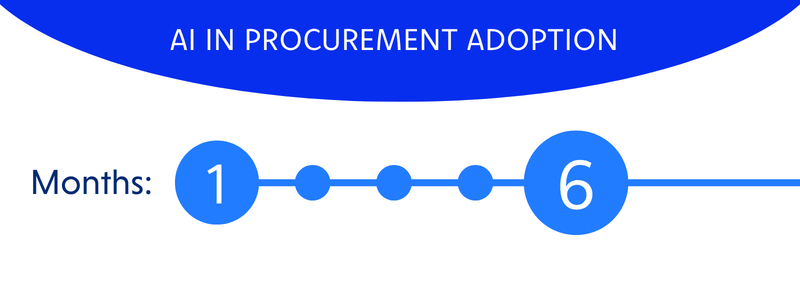
Getting procurement data to a level where AI can support sourcing decisions typically takes 12 to 18 months, assuming focused effort and leadership commitment.
Months 0–6: Data cleaning and standardisation
Supplier deduplication, spend normalisation, and category alignment across markets.
Months 6–12: Workflow embedding
AI begins to influence procurement decisions through use cases such as spend visibility and guided buying, where insights can be directly applied to purchasing behaviour.
Months 12–18: Scaled impact
More advanced use cases become viable as data quality improves and workflows stabilise.
This progression reflects the operational work required to move from insight generation to consistent decision-making.
Where AI Delivers Value First
The most effective starting point for AI in procurement is spend visibility and guided buying.
These use cases influence purchasing behaviour, improve compliance, and create early, visible results. They also establish a foundation where procurement teams begin to rely on data-driven inputs as part of their decision-making process.
That foundation is necessary before more complex applications can deliver consistent value.
The Organisational Shift Procurement Leaders in Asia Can't Avoid
The challenge is not just technical. It is organisational.
Procurement teams are typically measured on cost savings and compliance. They are not measured on decision quality.
Until that changes, AI will continue to produce insights without changing outcomes.
The dashboard will improve. The process will not.
Moving from transactional procurement to decision-driven procurement requires clear ownership, defined decision points, and accountability for acting on insights.
"Ultimately, leadership discipline — not technology capability — determines whether AI delivers real value."
The Bottom Line
AI does not create value in procurement. Decisions do.
Until AI is embedded into workflows, tied to ownership, and connected to sourcing decisions, most AI initiatives in procurement will stall. The organisations that succeed will not be the ones with the most advanced tools. They will be the ones that turn insight into action — consistently and at scale.